

Overview
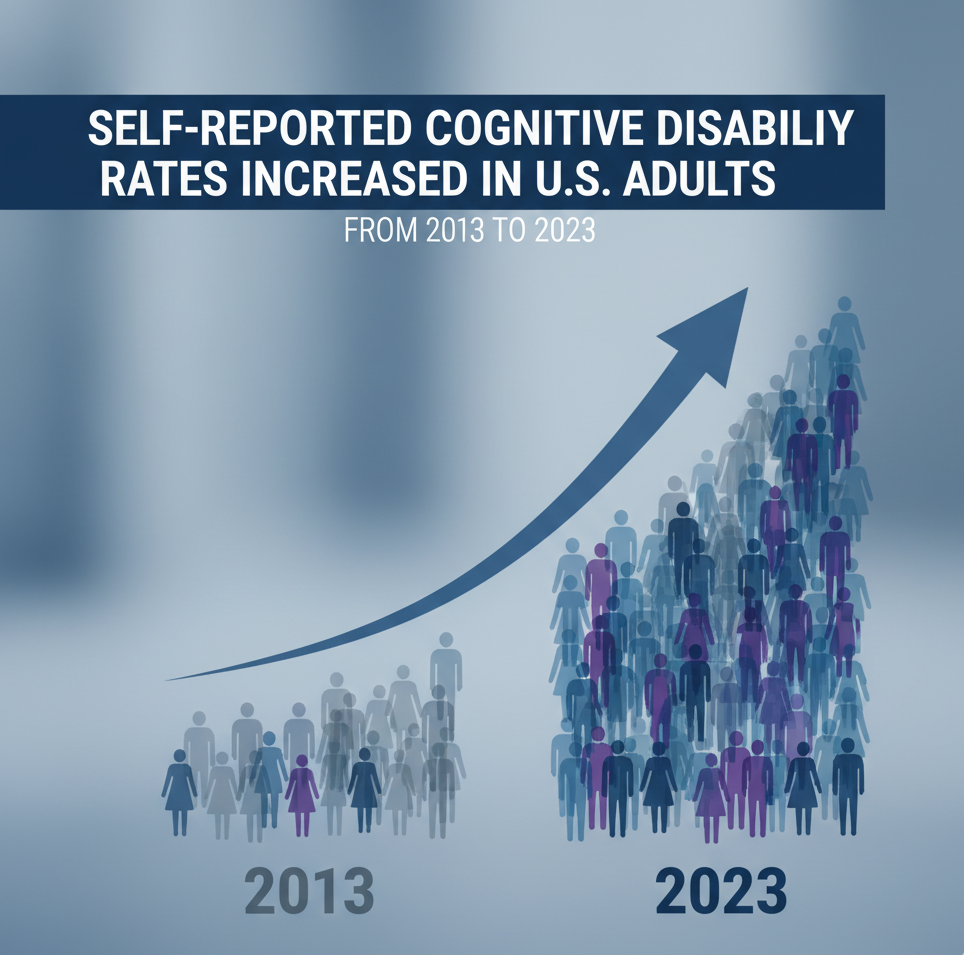
Over the past decade, the prevalence of self-reported cognitive disability among U.S. adults has risen markedly, highlighting a potentially growing public health concern. A recent study published in Neurology examined data from the Centers for Disease Control and Prevention’s Behavioral Risk Factor Surveillance System (BRFSS) spanning 2013 to 2023 (excluding 2020) and found that cognitive disability — defined in the survey as “serious difficulty concentrating, remembering, or making decisions” because of a physical, mental, or emotional condition — increased from 5.3 % in 2013 to 7.4 % in 2023 (age-adjusted)
Key Findings and Patterns
Timing and Overall Trend
The upward trend became statistically significant beginning around 2016 and persisted through 2023.
Over the full period, the analysis included more than 4.5 million survey responses from U.S. adults aged 18 and above (excluding those who self-reported depression)
The increase suggests that more Americans are experiencing—or at least reporting—serious difficulty with memory, concentration, or decision-making.
Age Group Differences
One of the most striking observations is the disproportionate rise among younger adults.
Among adults ages 18 to 39, the prevalence nearly doubled, from 5.1 % in 2013 to 9.7 % in 2023.
Middle age groups also showed increases: ages 40–54 rose from ~4.5 % to ~6.0 %, and ages 55–69 also increased (from ~5.1 % to ~6.0 %)
Interestingly, the oldest age group (70+) saw a slight decline — from about 7.3 % in 2013 to 6.6 % in 2023.
This pattern indicates that the overall rise in cognitive disability is being driven primarily by increasing reports among younger adults, rather than worsening among older populations.
Demographic, Socioeconomic, and Health Correlates
Beyond age, the study also documented disparities in cognitive disability across racial/ethnic, income, education, and geographic lines:
Race and ethnicity: American Indian/Alaska Native and Hispanic populations showed among the highest increases (e.g. American Indian/Alaska Native went from ~7.5 % to ~11.2 %) . Black, White, and Asian groups also exhibited rises, though the magnitudes varied.
Income: Adults with household incomes < $35,000 had the highest prevalence and largest increases (from ~8.8 % to ~12.6 %) . In contrast, those with incomes of ≥ $75,000 saw lower baseline rates (1.8 %) and more modest growth (to ~3.9 %) .
Education: People without a high school diploma had high and rising prevalence (from ~11.1 % to ~14.3 %), whereas college graduates had lower and slower increases (2.1 % to 3.6 %)
Chronic health conditions: Those with comorbidities — e.g. hypertension, diabetes, or history of stroke — also tended to report higher cognitive disability. These conditions are known to be associated with vascular or metabolic risk to cognition.
Geographic / regional variation: Regions in the South and Midwest had higher prevalence compared to the Northeast or West.
Interpretations, Limitations, and Implications
What does “self-reported cognitive disability” mean?
It is not the same as a clinical diagnosis of dementia or cognitive impairment: the measure relies on individuals’ subjective reports of serious difficulty in memory, concentration, or decision-making due to any physical, mental, or emotional condition.Because the study excluded respondents who self-reported depression, it aims to reduce conflation with major mood disorders, but subjectivity remains a limitation.
Rise in reports may reflect one or more of:
A true increase in cognitive difficulties in the population, perhaps due to rising stress, metabolic health trends, environmental exposures, or other unknown risk factors.
Greater awareness or reduced stigma, leading more people to acknowledge and report cognitive struggles.
Changed patterns in lifestyle (e.g. digital overload, sleep disruption, chronic stress) that may adversely impact memory and attention.
Contributions from post-COVID cognitive symptoms (“brain fog”) or other newer health stressors. Some have speculated that long COVID or pandemic-related effects may influence the trends, though evidence is preliminary.
Constraints and caveats
-
Self-report bias and recall error.
-
The survey excludes individuals institutionalized or otherwise unreachable by telephone.
-
Exclusion of 2020 data (due to disruptions) leaves a gap in trend continuity.
-
Because respondents with depression were excluded, some cognitive symptoms secondary to mental health may be undercounted.
-
The measure is broad and non-specific: “serious difficulty concentrating, remembering, or making decisions” captures a heterogeneous set of experiences and causes.
Public health and policy relevance
The upward trend, especially in younger adults, carries several potential implications:
If cognitive difficulties persist or worsen over time, there may be increased burden on healthcare systems and cognitive support services.
Workplace productivity and performance could be affected, given more adults reporting concentration or memory struggles.
The associations with socioeconomic disadvantage suggest that structural inequalities may be exacerbating cognitive health disparities.
Early intervention, prevention strategies, lifestyle modification, and better awareness are needed.
It behooves public health, neurology, psychiatry, and social services to consider cognition as a component of population health, not solely a concern of aging.
In sum, between 2013 and 2023 the prevalence of self-reported cognitive disability in U.S. adults rose from ~5.3 % to ~7.4 %, with the steepest increases seen among young adults. While causation is uncertain, the trend underscores the need for further research, monitoring, and preventive strategies targeting cognition as a public health dimension — particularly given the disparities across socioeconomic and demographic groups.
Our Products
-
Fenbendazole 500mg
$3.00 / Per Pill

-
Lisinopril 20mg
$1.00 / Per Pill

-
Ivermectin 12mg
$2.00 / Per Pill
